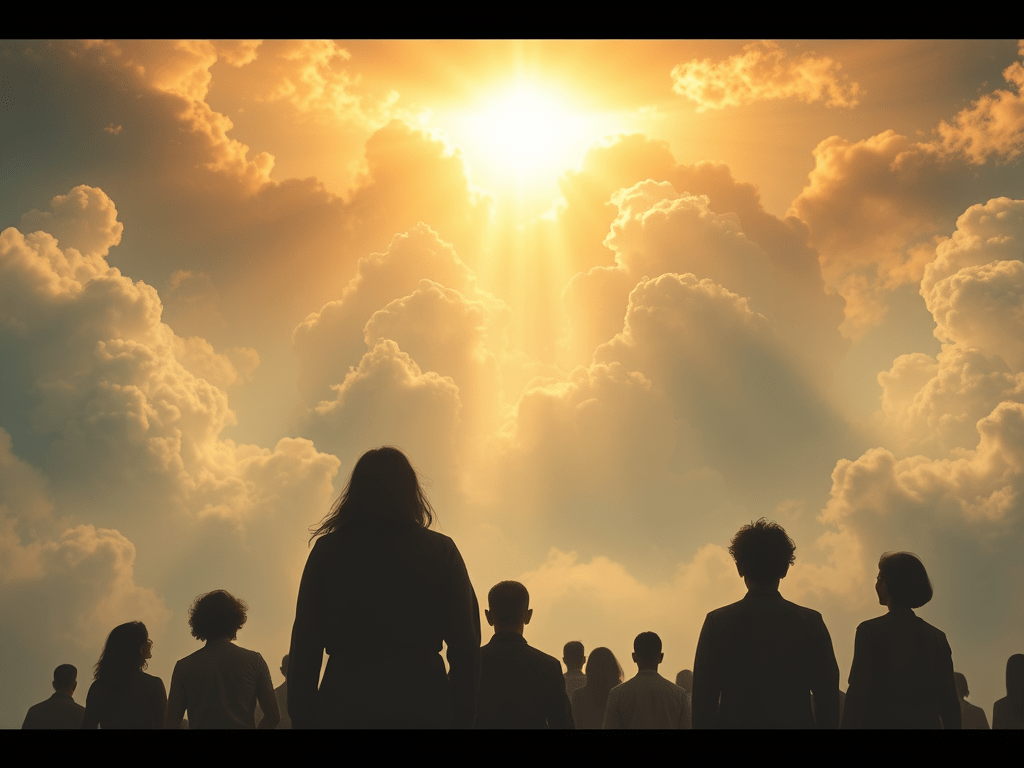
Why “woke” can be a doorway to Christ-consciousness — and why the loudest voices that rage against it may be the ones who have missed the gospel.
There is a story circulating through modern Christianity: one day the faithful will vanish in an instant, their bodies snatched into heaven while the earth below reels into tribulation. Hollywood and best-selling novels have made this secret “rapture” vivid in the popular imagination. But that dramatized scenario — a discrete pre-tribulation removal of believers as popularly depicted in films like A Thief in the Night or the Left Behind series — is a relatively new theology, born in the nineteenth century and popularized by dispensational teaching and later by mass media.
The Biblical texts most often appealed to are clear about hope, transformation, and the triumph of God’s life over death: 1 Thessalonians 4:13–18 speaks of being “caught up” (Greek harpazō) to meet the Lord; 1 Corinthians 15:51–52 promises that “we shall all be changed, in a moment, in the twinkling of an eye”; and the Gospels (Matthew 24 / Mark 13 / Luke 21) contain Jesus’ teaching about his coming and the signs that surround it. Read in literary and historical context, however, these passages more naturally point toward a climactic, visible coming of the Son of Man — a resurrection and vindication — rather than a private teleportation of the elect prior to tribulation. The “secret rapture” as an elaborate timeline (pre-tribulation rapture, seven-year tribulation, antichrist, etc.) is a schematic that theologians like John Nelson Darby systematized and that modern media codified.
But here is a complementary, and for many readers more urgent, insight: scripture also insists that the coming of God is not only an event out there; it is an event that breaks into hearts. John 14:1–3 promises a receiving; Luke 17:20–21 records Jesus saying, “the kingdom of God is in the midst of you” (some translations: “within you”). The early Christian mystical traditions — and even the non-canonical Gnostic texts such as the Gospel of Thomas and Pistis Sophia — emphasize inner knowledge (gnōsis), an awakening of the soul’s sight to God’s presence within. My dissertation Allegory of the Cross: Sophia Rising From the Cave argued along these lines: the “second coming” can be read as an interior realization — a rising of Wisdom (Sophia) within human beings that pulls us from the shadows into the light.
If we take that seriously, “being caught up” may not be so much a sudden exit from the world as an entry into Christ-consciousness — an embodied awakening to compassion, justice, and radical neighbor-love. It reframes eschatology: the end is not merely a calendar date to be anticipated; it is a spiritual dimension to be inhabited here and now by those who practice resurrection ethics.
This is why the contemporary battle over the word “woke” matters theologically and politically. To many, “woke” has become a political slur; to others it names an awakening to injustice and systemic harm. If “woke” means paying attention to suffering, listening to the marginalized, pursuing racial and economic justice, defending the dignity of LGBTQ+ people, and protecting people with disabilities — then it is precisely the kind of ethical awakening Jesus modeled: feeding the poor, standing with the outcast, breaking purity codes that exclude, and loving without condition.
Which brings us to a hard truth: there are powerful people today who loudly denounce “woke” while professing Christianity, yet whose political projects align with consolidating power, eroding civil liberties, and marginalizing the vulnerable. When religious language is used to justify cruelty or to mobilize fear (rather than mercy), we have to ask: by what fruit do we know them? Jesus warned against false prophets (Matthew 7:15–20) and named the danger of external religiosity that masks inner death. When those who claim to be defenders of faith wage spiritual warfare against compassion, it is not the Spirit leading but ideology protecting itself. In short: denouncing “woke” can be a tool of the very spiritual warfare the Bible warns against — a way for systems of power to confuse love for weakness and obedience for holiness.
If the second coming includes an interior, ethical dimension, then we are already witnessing a form of it when hearts awaken to Christ-like action. The resurrection is present wherever communities feed the hungry, welcome strangers, defend reproductive and civil rights, protect the disabled, and stand against laws that ban books or erase histories. This is not metaphysical escape; this is embodiment: the kingdom arriving as care enacted.
Of course, language matters. “Woke” is imperfect and easily caricatured. And institutions and movements that claim awakening are sometimes mixed, even messy. But the deeper point remains: to be awake in the way Jesus calls us is to be tender to suffering and relentless for justice. It is a spiritual posture that cannot be contained by partisan banners.
So what does a faithful response look like? It looks like discernment, not cynicism; prophetic courage, not fearful litmus tests. It looks like practicing the habits Jesus as well as other spiritual leaders taught — feeding, welcoming, defending, grieving with those who grieve — while reading scripture seriously and historically. It looks like listening to the Gospels’ scandalous priorities over a politics that would bend God to its ends.
In the end, whether you imagine rapture as a technical timetable or as a metaphor for transformation, the central claim of the Christian story holds: God’s life invades death, and love outlives cruelty. If we want to be ready for the coming of Christ, we might begin by cultivating the thing Jesus most prized — a heart turned toward the poor, the outcast, and the stranger. In that turning, the “second coming” is no longer something we await as spectators; it becomes something we embody together.

Leave a comment