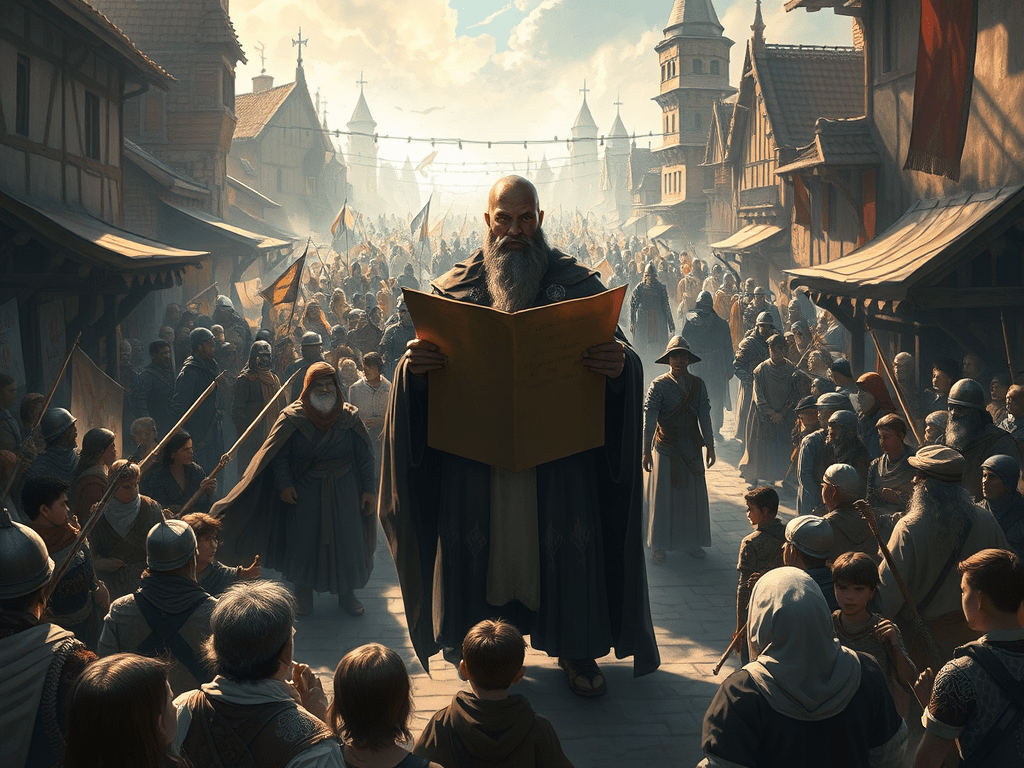
Three mornings after Elyon’s arrest, the Council called the people to the square. The bells rang at dawn, and soldiers herded merchants, workers, and children until the space was crowded and restless.
The High Scribe unrolled a thick parchment and began reading in a loud, steady voice. He spoke of shortages, waste, and disobedience. He said the people were “demanding everything without offering anything,” and that the Council could no longer allow such defiance. His solution was written in the new decree: all markets closed, all trade frozen, supplies rationed by soldiers only. “Until the people learn discipline,” the Scribe announced, “the Council will shut its hand.”
The people stood in silence. Everyone knew the storerooms in the upper quarter were full, that the Council members still ate meat and drank wine at their long tables. Shutting the markets would not starve the Council; it would only hurt the streets. But the Council framed it as sacrifice, insisting they were the only ones standing between order and collapse.
Amara watched from the edge of the crowd. Beside her, Garron muttered, “They think this will break us.”
“They don’t understand,” Amara said quietly. “We already stopped relying on them.”
She was right. In the weeks since the Law of Silence, the people had learned to survive without waiting for permission. Barter had moved into alleys and riverbanks. Neighbors pooled their grain and traded tools. The potter’s cups carried secret notches for those who needed to claim bread. Bakers and weavers marked their work with signs only the community could read.
The Council’s decree was supposed to tighten control, but it exposed how little control they had left. The soldiers patrolled harder, seizing loaves and tearing down stalls, but new ones appeared hours later in different alleys. Families quietly shared meals and looked after one another’s children. Life continued, not because of the Council, but in spite of it.
In his cell, Elyon heard one of the guards scoff, “They don’t need you anymore. They’re running their own trade.” The guard meant it as mockery, but Elyon smiled. That was always the point. Hope wasn’t meant to rest on one voice. It belonged to everyone willing to act like they were still human.
Back in the square, the Scribe’s words ended with a threat: “Until you obey, nothing moves.” But Amara saw it differently. As she walked home through streets alive with whispered trades and hidden songs, she realized something simple: the Council’s grip was already empty.
“They shut their hand,” she said to Garron. “But there was nothing in it.”
Amara had just finished mending a torn hem when Garron slipped inside her hut with news. His face was pale, his voice low.
“There’s someone inside the Council,” he said. “A man who claims to be on our side.”
Amara frowned. “Inside? That’s impossible. They trust no one.”
Garron nodded. “That’s what I thought too. But he sent a message through the potter. Said the Council is not as united as they pretend. He’s been copying decrees before they’re posted. He says he can tell us what they’ll do before they do it.”
The message came on a thin slip of parchment, folded small enough to fit under a coin. The handwriting was careful and formal—like the ink of a clerk trained in law. The note read: The Council’s hand is not one hand. Cracks widen. I will widen them further. Watch for the seventh mark.
Amara turned the slip over and saw a faint symbol etched into the corner: seven small strokes, nearly invisible. Elyon’s mark.
Her heart pounded. “If this is real,” she whispered, “someone has carried Elyon’s fire into their chambers.”
The next week proved the message true. Before the Council declared that new taxes would be levied on farmers, a warning reached the riverbank first. Farmers pulled their wagons back into the woods before soldiers could confiscate their goods. Another time, the Council planned to seize weavers’ cloth at the dye house, but the bolts had already been spirited away. Every time the Council tried to close its hand, they came up grasping nothing but air.
The captain grew suspicious. Patrols doubled again. Informants were promised coin for names. The Council thundered louder in the square, insisting their unity was unbreakable. But inside, their meetings turned sour. Arguments stretched late into the night. Rumors whispered of votes that were split, of one voice urging caution while others demanded punishment.
The people didn’t know the name of their ally. Some thought it must be a young clerk, sick of seeing lies written on broadsheets. Others said it was a gray-haired elder, biding his time after decades of service. Whoever he was, he signed each message the same way: the seventh mark.
Amara lay awake at night, wondering. Was this a trap meant to flush them out? Or was it the beginning of something even the Council could not contain—resistance blooming not only in the streets, but in the very chamber where the laws were born?
Garron whispered one night, “If they have cracks inside, they will fight each other as much as they fight us.”
Amara held the slip with the seventh mark close to her chest. “Then we must be ready. Shadows fall quickest when light rises from within.”

Leave a comment